
The Organs at St. John’s
1873: Hook & Hastings Organ
The first organ in St. John’s current building was a Hook & Hastings, installed shortly after the church’s dedication in 1873. The $10,000 cost of the instrument was a gift to the Parish from Abram Ives. (This is equivalent to over $280,000 in 2026 dollars.) The case of this organ was not as wide as the gallery and access to the attached console was provided through the doors adjoining the north and south stairs. The side balconies were not connected to the organ loft at that time. The Hook & Hastings stood between the front lancet windows (now blocked), below the rose window and had tubular pneumatic or tracker action.
Retained from that organ, and incorporated in the 1956 and current McManis, are the Pedal 16′ Prestant (Diapason) visible from the nave, and 16′ Subbass, the 16′ Swell Bourdon and 8′ Corna d’Amore (Oboe-Bassoon). Thus, it can be said that in the current organ, several stops and their associated pipes are over 150 years old.
Sometime in the early years of the 20th century, the first “expansion” occurred with the installation of the Hall organ – actually a rebuild of the Hook & Hastings. Pipe facade and case were extended to the full width of the gallery. With chest action electrified, the console could be relocated to the chancel area behind the pulpit (slightly different floor tiles there indicate its position to this day). A fourth manual division was added. Retained from the Hall organ is the Pedal 16′ Violone/8′ Cello of 44 pipes.
1956: The McManis Gallery Organ
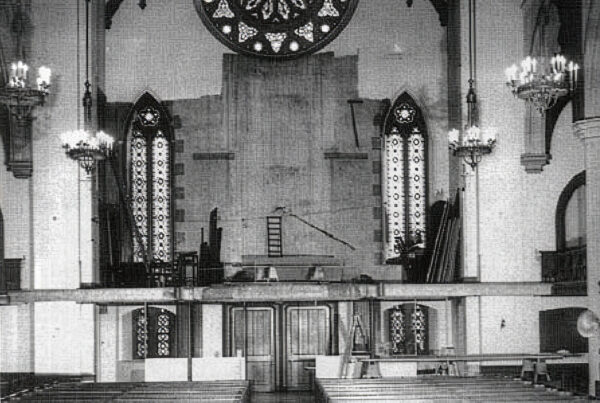 The magnificent Gallery Organ at St. John’s was built in 1956 by Charles W. McManis in consultation with Jerome Meachan and Parvin Titus, at a cost of $43,500 (equivalent to $536,000 in 2026 dollars). Mr. Titus, Professor of Organ at the Cincinnati Conservatory, was the first American student of Marcel Dupre. The installation was completed in June of 1957, with the dedication taking place at a Recital Celebration by Mr. Meachan in October of the same year.
The choice of a relatively unknown independent organbuilder in 1956 was unusual for its time. Large, integrated firms had dominated the organ building market since the turn of the century – some producing more than 100 instruments per year.
But after hearing several McManis organs in Connecticut and beyond, Meachen said:
“Charles inspired my definition of intensity because he viewed the entire instrument as a whole. In a three-manual [three keyboard system] you could draw the principal and mixture on each division, couple them together and you had a basic ensemble evoking a very intense, rich but not very loud sound because you didn’t have to fill in and thus did not have an awful lot of stops working… You are dealing with colors and when you [use] everything [at the same time] you end up with gray.”
 Meachen and St. John’s Church selected Charles McManis as its new organ builder because he believed deeply that an organ should be something other than loud or physically imposing. It should belong to its space and serve the liturgy. He resisted one-size-fits-all designs, insisting instead that every instrument be shaped by the room, the congregation, and the musical life it was meant to support.
Most important, it should invite musicianship rather than intimidate it.
McManis’s career spanned more than six decades, from the late 1930s until his retirement in 1999. He designed, built, re-built, or restored 140 pipe organs that are installed in churches, colleges, and private homes in 21 different states. His instruments ranged from modest to monumental, but all were marked by meticulous craftsmanship, mechanical reliability, and a clear, singing tonal palette.
St. John’s gallery organ is formally named McManis Opus 35.
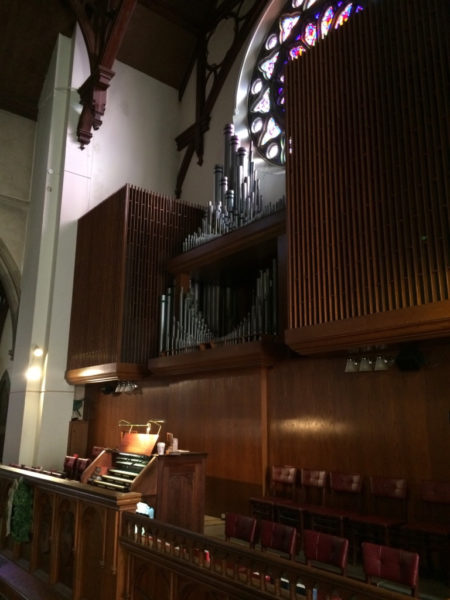
Perfectly suited in size to the 400-plus seating capacity of the Church, the Gallery Organ contains 54 ranks (2,175 pipes) and is played from a console located in the rear gallery. Also playable from this console, or its own smaller console in the chancel, is the Chancel Organ of 6 ranks (378 pipes), installed by the Austin Organ Company in 1964.
Combined, the two instruments include 60 ranks with 2,553 speaking pipes. The largest pipe measures 16 feet in length, or about the height of a two-story building, while the smallest is about the size of a lead pencil.
In 1956, the organ loft was extended to the side balconies and the narthex was created. The McManis organ built at this time was designed to be more shallow than the Hall case to accommodate choir seating, and to emphasize vertical lines in the broad gallery, without blocking the rose window. Swell boxes of the previous instruments had obscured the lower portion of the rose. Duplicate three-manual consoles were placed in the rear gallery and side balcony opposite the chancel organ case. This arrangement was changed in the early 1960’s when the current Austin console was placed in the gallery.
1989: Rebuilding the McManis Organ
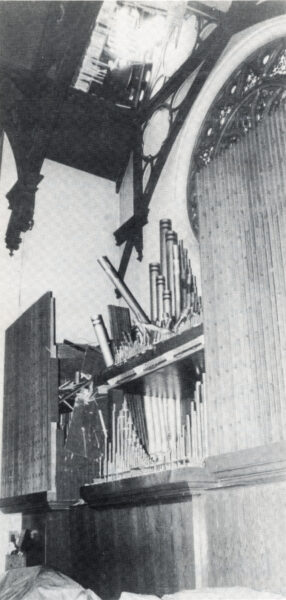 St. John’s McManis organ suffered enormous damage in the tornado of July 10, 1989, when stones from the tower fell through the roof above the rear gallery. A twelve-foot-diameter hole in the roof let in the drenching rain, ruining the leathers, after the huge stones had smashed pipes and damaged chests. Many called it a tragedy. But was it? We think not.
Most importantly, no one was hurt. Neighbors and friends came by or sent words of support. Many just stood in silence, shaking their heads. However an organ, even the “Mighty McManis”, is a “thing” and could be replaced. To our immense delight we learned that Charles McManis was able and interested in the project. As people conjectured about whether he might still be alive, he assured us, like Mark Twain, that reports of his death were greatly exaggerated, and that “I can still stand up and still hear.” Indeed so! Charles McManis, in conjunction with Charles and Christopher Aitken have rebuilt our wonderful instrument. Insurance and generous donations enabled us to finance the project. (McManis’s bill for the work was $165,970… roughly $431,000 in 2026.)
All pipework has been replaced, courtesy of the tornado, except for old ranks mentioned above, pipes of the Brustwerk division, and those on the Pedal chest behind it. Note as you look over the current Specifications that: the Swell 4′ Dulzian has been replaced by a Clarion, the Brustwerk Singend Regal has been replaced by a Krummhorn and the Pedal 32′ Contra Fagotto replaced by a 32′ Contra Posaune (the German Bible reports that the type of instrument blown by Gideon’s men when the walls came tumbling down was the Posaune. Plural: Posaunen).
Out of the “ashes” of this disaster we have gained a widened and clarified vision of the purposes such a “gift” offers. St. John’s is a place where God is found in the ministries of the men and women and children who call it their home. It is a place where the artistic creations of hu-mankind are given space and energy to enrich us all. The “Mighty McManis” is ready, and the doors are open.
Reputation
Since its installation, St. John’s McManis Organ has gained the well-deserved reputation of being one of the most exciting and versatile organs in New England. Featured in articles appearing in The American Organist (Jan. 1958) and William H. Barnes’s book The Contemporary American Organ. it has drawn recitalists of international stature, including Grammy Award winner Paul Jacobs, Christopher Houlihan, Marie-Claire Alain, Robert Anderson, Michael Chapius, Marilyn Kaiser, Donald McDonald, Noel Rawsthorne, Berg Zamcochian, Brian Jones, Gerre Hancock, Clyde Holloway, Thomas Brown, John Obetz, and Christa Rakich. In addition, many talented and capable local organists have performed outstanding recitals here in recent years. Organ enthusiasts from throughout the New England area attend these recitals; inquiries about the “Mighty McManis” and St. John’s Music Ministry are received regularly from across the country.
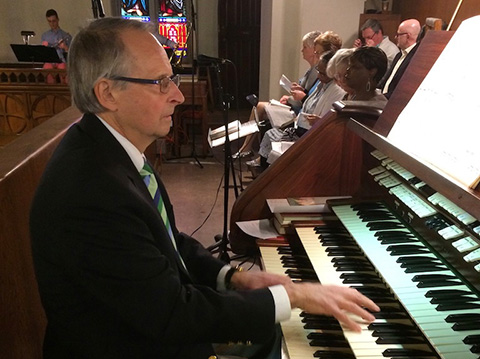 Robert Havery, who has served as Minister of Music and Organist at St. John’s from 1969 until 1986 and then again from 1996 to the present, wrote the following:
“The McManis organ at St. John’s is considered to be an outstanding example of mid 20th century organ building. Its tonal design was influenced by the neo Baroque movement, so it has the brightness of 18th century German organs that Bach would have known. It also has stops that make it possible to convincingly play 19th century Romantic and 20th century modern music. It is the kind of instrument that has often led recitalists to applaud the organ at the conclusion of their recital.
“There are three things that make this instrument exceptional:
“First, the beauty of its tone, which is enhanced by the outstanding acoustics of the church. The full organ is majestic, and has given this organ its nickname The Mighty McManis. In addition, the softer stops have a lustrous quality about them that can bring alive a quiet piece of music, and the flute and reed choruses are rich and full.
“Second, its responsiveness. The touch of the organ is very even and quick so the organist feels that he/she can shape a phrase or articulate the notes of a passage of music.
“And third, its versatility to convincingly play several different historic periods of organ music. This includes the full organ of Baroque music, consists of the choruses of three divisions, Great, Swell and Brustwerk, each with a mixture designed to fit one on top of another, producing a full, rich, brilliant tone. There are good solo stops for this period, including two cornets and two solo reeds. The full reed division is a robust chorus for French Baroque music when used alone, and a brilliant full organ for 19th and 20th Century music. A large Pedal division provides a foundation that can shake the floor of the church… really!!”
Stop List
 GREAT (manual I, unenclosed, keyboard on BOTTOM)
16′ Quintaton
8′ Principal
8′ Rohrgedeckt
4′ Octave
4′ Flute
2-2/3′ Quinte
2′ Blockflote
1-3/5′ Tierce
III-IV Mixture
16′ Fagot
Tremolo
SWELL (manual II, enclosed in 2 chambers: flutes left, reeds right)
16′ Lieblich Gedeckt
8′ Geigen
8′ Stillflote
8′ Gemshorn
8′ Gemshorn Celeste
4′ Principal
4′ Rohrflote
2′ Octave
III-IV Scharf
16′ Contrafagotto
8′ Trumpet
8′ Corno d’Amore
4′ Dulzian
Tremolo
BRUSTWERK (manual III, unenclosed)
8′ Quintade
4′ Spitzflote
2′ Principal
1-1/3′ Larigot
1′ Sifflote
II Sesquialtera
III Cymbal
8′ Regal
Tremolo
PEDAL
32’ Contrabass
16′ Prestant
16′ Violone
16′ Subbass
16′ Quintaton (Gt.)
16′ Lieblich Gedeckt (Sw.)
8′ Principal
8′ Gedeckt (Sw.)
8′ Violoncello
4′ Octave
4′ Gedeckt (Sw.)
2′ Nachthorn
III Mixture
32′ Contrafagotto (ext.)
16′ Posaune
16′ Contrafagotto (Sw.)
16′ Fagot (Gt.)
8′ Trumpet
4′ Clarion
CHANCEL (playable on Great or Swell)
8′ Gedeckt
8’ Flute Celeste
4′ Principal
4′ Flute
2′ Octave
Chancel Pedal
16′ Bourdon
8’. Bourdon
COUPLERS
Swell to Great 16′
Swell to Great 8′
Swell to Great 4′
Brustwerk to Great 8′
Brustwerk to Swell 8′
Great to Pedal 8′
Swell to Pedal 8′
Swell to Pedal 4′
Brustwerk to Pedal 8′
Sw. Reeds to Brustwerk
PISTONS/TOE STUDS (capture system)
12 General
6 for each Manual and Pedal
REVERSABLES
Great, Swell, Brustwerk
CRESCENDO PEDAL
Preserving a World-Class Instrument
Please consider contributing to the St. John’s Organ Fund, in any amount, by clicking here to make a gift today.
Music Ministry
“Ministry” reminds us of the primary purpose for which this or any church organ is built: to enhance the worship of God. Good music, which is prepared and performed as competently as possible and is suited to the needs of the church year and those who worship here, has been a long-standing priority of the Music Ministry at St. John’s.
The McManis serves the Parishioners of this church in many ways. As part of our worship together, it provides support for congregational singing, accompanies anthems sung by the choirs and, of course, is used for solo music, such as preludes, postludes and sequence music. As our Music Ministry reaches out to involve the Greater Waterbury Community, the organ is used for solo recitals, with orchestra in concerti, and to lead the large combined-choir festivals so popular in the area This wonderful instrument possesses the size, quality, and diversity of tone to meet the demands of all these functions in an exceptional manner.
Keeping Things Together
Pipe organs are incredibly complicated instruments, combining a vast array of sophisticated mechanical devices and wiring circuits. In addition, an intense level of artistry and craftsmanship is required in the tonal voicing of pipes. High quality pipes are the most durable part of an organ. Some instruments, including this one, may actually contain pipes from previous organs if they are deemed by the builder to be suitable; this does not necessarily reduce the cost of building an organ but may add the richness known to exist from an earlier instrument. Time and environment affect other parts of the organ more quickly, attacking wind chests, reservoirs, electro-pneumatic valves, and other switches and relays. Prior to regulations promoting clean-up of the air in cities, organs located in urban areas were especially subject to damage from pollutants. Although there are no absolutes regarding pipe organ longevity, American instruments of electro-pneumatic action construction, such as this one, should provide dependable service for a period of 25 to 40 years, occasionally exceeding that span by a good deal more.
Looking Ahead
Organ sounds imitative of orchestral instruments, other than flutes trumpet, trombone, clarinet, oboe, bassoon – are produced by ranks of reed pipes. Their sensitive brass reeds and resonators are subject to wear from frequent tunings and too-often-rolled tuning rolls. Replacement of reed ranks unaffected by the storm seemed the practical, artistic thing to do, even though the cost was not covered by the storm insurance.
On-going maintenance, tuning and care help keep a treasure like St. John’s McManis organ ready for its most important role: enhancing the wor-ship of God. In addition, profes-sional organists from around the world come to play this magnificent instrument for their own enjoyment as well as that of the concert-going public. Contributions to st. John’s Organ Fund are always appropriate and welcome.